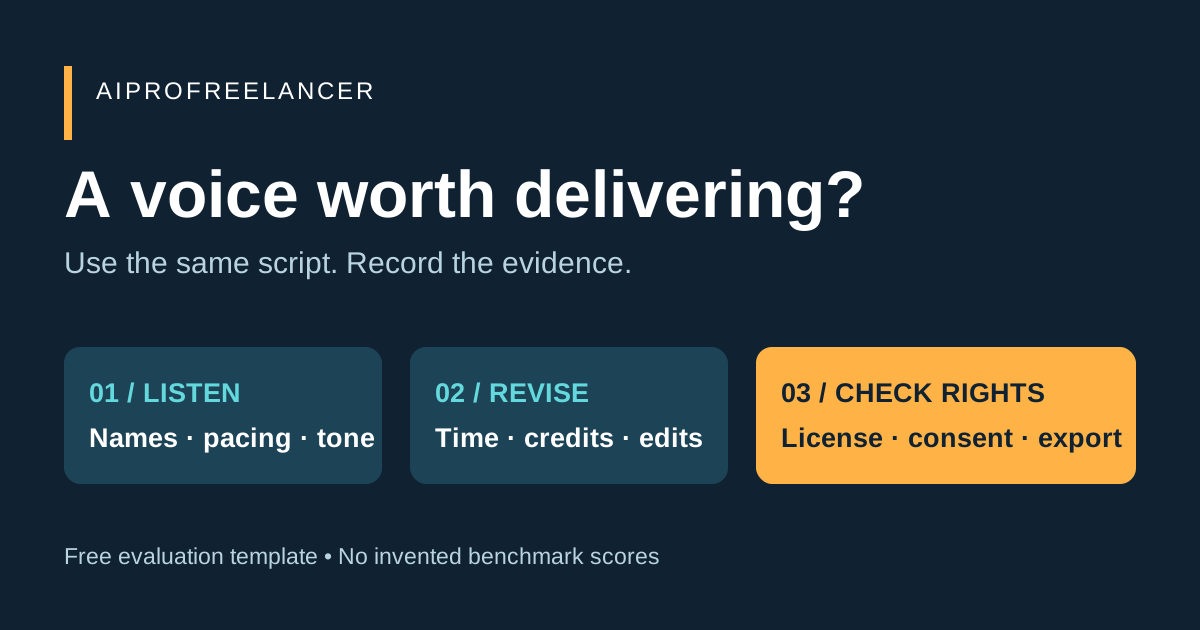
A convincing voice demo is a starting point. For a freelance project, the more useful test is whether the voice can pronounce your script, survive revisions and meet the client’s delivery requirements. Use a repeatable scorecard before choosing a subscription.
This guide provides an evaluation method, not a hands-on ranking. We have not measured the tools against this scorecard yet. A high listening score also does not establish commercial rights or permission to clone a person’s voice.
Disclosure: This page links to reviews that contain affiliate links. Those reviews identify the referral relationship. There is no paid recommendation in the blank scorecard.
Download the free voiceover evaluation scorecard .
Choose your next step
- Still comparing output? Start with the sample and scorecard below. Keep pronunciation and revision observations before choosing a plan.
- Already considering ElevenLabs? Use the ElevenLabs buying checklist to check commercial-use requirements and billing, then fill in the project budget worksheet . It includes space for retries and client rewrites.
- Not ready to subscribe? Download the blank scorecard and record requirements first. A worksheet does not require a paid account.
Start with one representative script
Choose a short script that resembles the work you actually deliver. Include a person’s name, a specialist term, a number, an abbreviation and a sentence that needs a deliberate pause. Keep the script identical across tools so that changes in the text do not distort the comparison.
Use invented project details or material you have permission to process. Do not upload confidential client information merely to obtain a more realistic demo. Record the language, accent, intended audience and required output format alongside the script.
Keep each original output. A later edited sample cannot tell you how much work the first version required. Label files with the tool, selected voice and date rather than overwriting them.
Listen for the problems that create revisions
Score pronunciation, numbers, pacing, tone and consistency from one to five. Define five as ready for this specific project, not universally perfect. Write down the sentence or timestamp that supports each score.
For names and technical terms, listen to the entire sentence rather than an isolated word. For numbers, check what the listener would understand: an account identifier, a price and a year can need different delivery. For pacing, ask whether the pauses help the audience follow the explanation.
Avoid averaging away a critical failure. If an important product name remains wrong after revision, the sample may be unsuitable even when its tone sounds polished. Record that blocker explicitly.
Measure the revision workflow
Change one sentence and try to preserve the surrounding delivery. Record your active editing time, the number of regenerations and the usage consumed if the interface shows it. These observed values are more useful than a general claim that a tool saves hours.
Separate active editing time from waiting for generation. Also separate the first output from the final acceptable output. If you estimate project cost, state the plan, allowance and number of expected revisions; do not treat the introductory subscription price as the entire production cost.
Use the freelance tool cost worksheet to combine those revision hours with the billing commitment and required add-ons. Keep the subscription payment due now separate from the share allocated to this voiceover project.
Treat rights and exports as separate gates
Before delivery, verify the selected plan’s current commercial-use terms, the client’s distribution channel and the required download format. Record the source and the date checked. A trial that lets you generate speech may not let you download or commercially use that output.
For uploaded or cloned voices, document the relevant permission before testing. A quality score cannot replace consent, and access to a voice feature does not itself prove that a particular person’s voice may be used.
Our ElevenLabs buying checklist and Murf trial and licensing checklist explain the plan questions to investigate. Read the current vendor documentation before committing to a client deliverable.
Make a project-specific decision
Use four possible outcomes: reject, revise, shortlist or ready for the specified project. Keep the remaining blockers visible. Repeat the evaluation when the script, voice, model or plan changes substantially.
The scorecard becomes useful evidence when filled with real observations. Until then, it is a planning template and should not be presented as proof that one provider outperforms another.