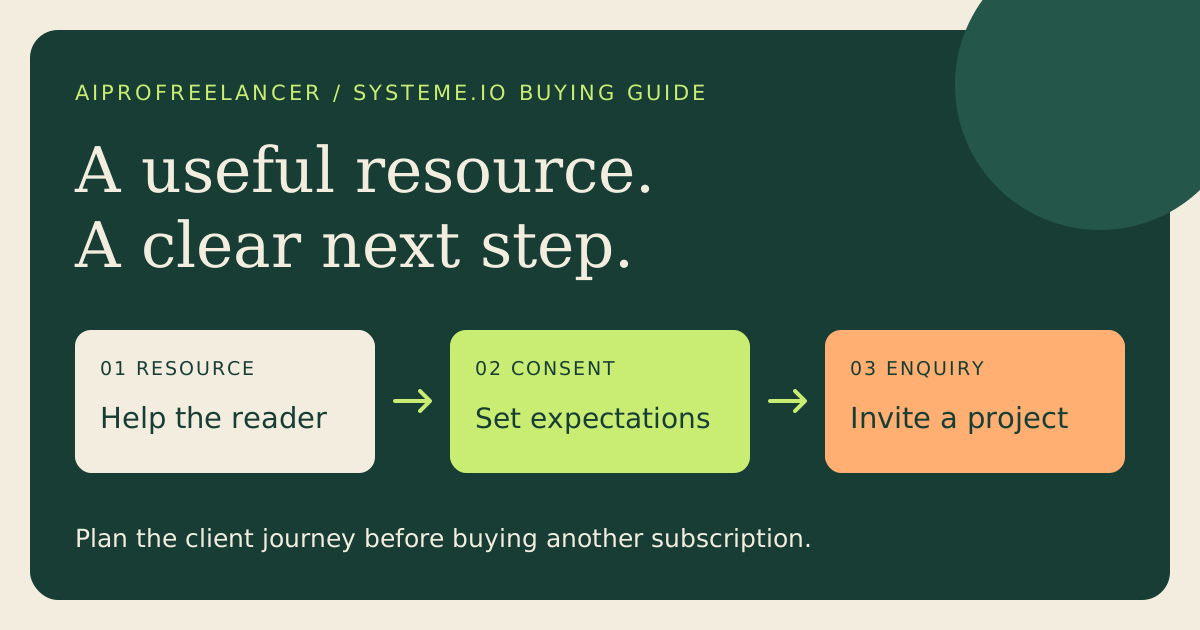
Best for a first funnel, email list and digital product: Systeme.io Free. Upgrade when a capacity limit blocks your next launch. Pick ClickFunnels instead if your business already relies on its workflows and rebuilding would cost more than the subscription saving. For a new solo business, my recommendation is to validate the offer on Free before paying.
Disclosure: The three Systeme.io CTA links below are affiliate links. If you purchase through them, we may earn a commission at no extra cost to you.
Based on official pricing and documentation checked November 4, 2026; this is a document-based buying guide, not a hands-on review.
Black Friday 2026: No 2026 sale was confirmed on the official pages checked November 4. Read our Systeme.io Black Friday guide for regular annual prices and which plan to pick.
Systeme.io pricing: which plan should you buy?
For a focused upgrade decision, read our Systeme.io pricing guide , including the Free plan’s lifetime sales cap and what to check before changing subscriptions.
The table uses USD monthly billing. The recommendation column is our buying judgment based on capacity, rather than an assumed conversion benefit.
| Plan | Monthly price | Contacts | Sales funnels | Courses | Best fit |
|---|---|---|---|---|---|
| Free | $0 | 2,000 | 3 | 1 | Validate a first offer |
| Startup | $17 | 5,000 | 10 | 5 | Expand a working small business |
| Webinar | $47 | 10,000 | 50 | 20 | Add evergreen webinars or capacity |
| Unlimited | $97 | Unlimited | Unlimited | Unlimited | Operate beyond the lower tiers |
Source for prices and capacities: Systeme.io pricing FAQ , checked November 4, 2026. It also states that Free has no expiry and requires no credit card.
Start with monthly billing while validating the workflow. The pricing page advertises annual billing with two months free, but a lower monthly equivalent means an upfront commitment. Check the annual total, currency and taxes at checkout before choosing that option.
Use the project cost worksheet to record subscriptions, domain costs, payment processing and time needed to move existing pages. A cheaper subscription helps only if it replaces something you actually need.
Free plan limits: what can stop you first?
The easy mistake is to watch only contact growth. Free also limits you to one automation rule, one email campaign and one custom domain, according to the official Free plan FAQ , checked November 4, 2026.
For a simple resource funnel, that can be enough: collect permission, deliver the download and follow up with a relevant offer. It becomes restrictive when you want separate onboarding journeys for different products. Sketch those journeys before importing an audience. A small list with several offers may outgrow the automation allowance before it outgrows the contact allowance.
Download the blank lead-funnel checklist and adapt it to your audience and product. Write down the entry page, promised resource, follow-up and purchase destination. Filling out this worksheet does not establish that the funnel works.
There is an inconsistency on the pricing page: its benefits section says unlimited students, while its Free FAQ mentions 500 students. If learner capacity determines your purchase, obtain confirmation from support rather than planning around the more generous statement. Source: pricing benefits and Free FAQ , checked November 4, 2026.
When is a paid plan worth it?
Startup: expand a working offer
Startup is my first paid recommendation when Free cannot accommodate your real product lineup or audience. Keep a short upgrade note: what is blocked, which allowance fixes it, and when you will use that allowance. If you cannot name the blocked task, continue with Free.
A creator preparing another course should count every course that must remain available, including older purchases. Do not remove customer access just to squeeze a launch into a cheaper plan. Similarly, list cleanup should remove unwanted records, not consenting readers who still want your emails.
Webinar: add an evergreen presentation
Choose Webinar when an evergreen presentation is central to your offer or Startup capacity no longer fits. Before buying, outline the presentation, registration message, follow-up and product. A webinar feature cannot rescue an unclear offer or generate an audience by itself.
If your launch uses a live meeting hosted elsewhere, do not assume the plan name makes this upgrade necessary. Identify what the built-in workflow would replace and whether you will use it regularly.
Unlimited: remove an operational bottleneck
Shortlist Unlimited when smaller tiers would force you to split a working business across accounts or remove useful assets. It should simplify an operation you already have. Do not buy it merely because a growth forecast looks attractive.
Compare Systeme.io plans for your next launch
Systeme.io vs ClickFunnels: compare cost and fit
| Buying criterion | Systeme.io | ClickFunnels Launch |
|---|---|---|
| Entry option | Permanent Free plan | Free trial advertised |
| Paid monthly entry | Startup: $17 | Launch: $97 |
| Contacts at paid entry | 5,000 | 10,000 |
| Email sending | Unlimited sends across plans | 50,000 emails per month |
| Recommended buyer | Solo creator combining basic tools | Business needing a specific ClickFunnels workflow |
Systeme.io figures: the pricing FAQ above and official email-volume and contact guide , checked November 4, 2026. ClickFunnels figures: official Launch pricing and inclusions , checked November 4, 2026. Monthly prices are compared with monthly prices.
For a new creator, I would shortlist Systeme.io first because you can check the journey without starting a paid subscription. An established ClickFunnels user should price migration before switching: rebuilding checkout pages, recreating sequences and checking customer access all have a cost. This recommendation concerns budget and workflow, not measured conversion performance.
Use the Systeme.io versus ClickFunnels project checklist to compare the same offer on both platforms. If your main need is a newsletter, the Kit subscriber journey and export checklist provides another evaluation route.
Who should choose Systeme.io, and who should not?
Choose it if you are a solo creator or affiliate publisher who wants a connected landing page, permission-based follow-up and digital offer. The strongest reason to try it is to reduce the number of tools involved in a simple customer journey.
Stay with Free while learning which resource attracts the right readers and which product they want. Spending on capacity before you have a usable offer adds cost without solving that uncertainty.
Investigate alternatives first if your purchase depends on a specialist integration, complex access controls or a precise learner allowance. Make that requirement your first acceptance check. A feature list does not establish compatibility with existing systems.
The most concrete downside is that exceeding allowances can interrupt operations. Systeme.io documents warnings and restrictions when contact or feature limits are exceeded, including after a downgrade. Review the plan summary before reducing your subscription. Source: official account restriction process , checked November 4, 2026.
Unlimited sending does not establish inbox placement. Authenticate the sending domain and use a permission-based list before evaluating performance. The official email-volume guide cited above recommends domain authentication and list hygiene. Its published account results are vendor evidence, not a forecast for your list.
How to test it yourself in 15 minutes
This is a suggested initial check, not a promise that a production funnel takes 15 minutes to build.
- Define the journey. Choose a resource you own and a relevant product. Write the promise and next action in plain English.
- Build a draft page. Add a signup form to a template and inspect the mobile preview. Request only necessary personal data.
- Connect delivery. Configure the follow-up to deliver what the page promises. Use your own test address rather than a purchased or scraped list.
- Walk through as a subscriber. Check confirmation, resource delivery and unsubscribe. Record missing messages or duplicate triggers.
- Check the purchase path. Preview your own product journey without a live charge. For affiliate offers, verify destination and traffic permissions without self-clicking a referral link.
- Write the decision. Record what worked, what failed and the allowance needed to resolve a blocker. Keep Free unless upgrading solves that blocker.
FAQ
These questions follow the public pricing FAQs and restriction documentation cited above; they are not claimed as Search Console queries.
Is Systeme.io really free, or is it a trial?
It is a permanent free tier with capacity limits. Use it to validate the signup-to-delivery journey before subscribing. Free is the recommended starting point for an unproven offer.
Which free-plan limit should I check first?
Check your workflow, then its allowances. Contact count is only part of the decision: multiple products may need separate follow-up journeys even when your list is small.
When should I upgrade to Startup?
Upgrade when a needed task exceeds Free and Startup covers it. Keep a written reason for the purchase so you can review whether the added capacity is being used.
Do I need Webinar to sell a course?
No. The comparison above includes course capacity on lower tiers. Choose Webinar for evergreen webinar functionality or higher allowances rather than assuming every course needs a webinar funnel.
Can I cancel or downgrade later?
The pricing FAQ says cancellation keeps the current plan until the next billing date, then returns the account to Free. Review restrictions before downgrading an account with assets above the lower allowance. Source: official cancellation and downgrade FAQ , checked November 4, 2026.
Verdict: pay for a named constraint
Systeme.io deserves a shortlist place for a small business combining funnel, email and course delivery. Start with a focused offer, verify the subscriber experience and upgrade when the next plan fixes a concrete limitation. Include migration and maintenance in your buying decision.
Start with the free Systeme.io plan