Best for a first affiliate funnel with pages and email in one place: Systeme.io Free. Choose Startup when a working funnel needs more capacity. Consider Kit instead for an original-content newsletter with occasional affiliate recommendations.
Disclosure: Some links are affiliate links. We may earn a commission if you purchase through them, at no extra cost to you.
Based on official pricing and help documentation checked November 13, 2026.
A bridge page should help someone decide whether an offer fits. Use it to explain the problem, compare options and disclose your referral relationship before sending readers to the merchant. This guide proposes a small funnel you can build around a useful checklist, rather than a page that merely forwards traffic.
Free vs paid: what an affiliate funnel actually needs
Prices below are USD with monthly billing. The final column is our recommendation.
| Plan | Monthly price | Contacts | Funnels | Best fit |
|---|---|---|---|---|
| Free | $0 | 2,000 | 3 | One focused audience and an initial offer |
| Startup | $17 | 5,000 | 10 | More capacity for an established funnel |
| Webinar | $47 | 10,000 | 50 | A larger list or evergreen webinar strategy |
| Unlimited | $97 | Unlimited | Unlimited | A business exceeding the smaller tiers |
Free includes one email campaign, one automation rule and one custom domain. Email sends are unlimited; the plan does not expire or require a credit card. Source: official subscription prices and Free allowances , checked November 13, 2026.
Build around those constraints: one opt-in, one helpful follow-up sequence and one buying problem. Trying to send different audiences into separate campaigns creates an upgrade question before you know which offer attracts qualified readers. Our Systeme.io pricing breakdown covers the wider subscription decision.
Systeme.io vs Kit for affiliate marketers
| Buying question | Systeme.io Free | Kit Free |
|---|---|---|
| Entry price | $0 | $0 |
| Audience allowance | 2,000 contacts | Up to 10,000 subscribers |
| Page capacity | 3 funnels | Unlimited landing pages and forms |
| Our preferred use | Connected opt-in and bridge-page journey | Original-content newsletter with occasional recommendations |
| Main decision constraint | Limited campaign and automation capacity | Affiliate-only content is not a fit under Kit’s guidance |
Sources: the Systeme.io pricing source above and official Kit Free pricing and page allowances , checked November 13, 2026.
Kit explicitly expects creators to have their own business or content outside affiliate marketing. Its guidance allows clearly labeled affiliate recommendations within original content, but rejects a business consisting solely of affiliate emails. Source: Kit’s explanation of permitted affiliate content , checked November 13, 2026.
Choose by publishing model, not just list size. A newsletter teaching photography with occasional equipment recommendations deserves a different evaluation from a funnel built around software buying decisions. Check the proposed content against the provider’s current requirements before importing subscribers.
If you already use a dedicated funnel platform, our Systeme.io vs ClickFunnels comparison helps assess whether rebuilding is worthwhile.
Who should choose Systeme.io, and who should not?
Choose Free if you have a specific audience, a useful resource and a merchant offer that solves the same problem. An example is a freelance consultant sharing a lead-follow-up worksheet and explaining when a funnel tool becomes useful.
Choose Startup when the next audience or offer needs capacity you cannot reasonably fit into the existing setup. Identify the blocked resource in your account before upgrading. Extra funnels alone will not repair a vague promise or an irrelevant recommendation.
Delay buying software if you cannot explain where readers will come from. Start by writing the resource and the decision guide. A subscription supplies infrastructure; you still need useful content and a repeatable way to reach people interested in it.
Avoid forcing an established business into this simple setup when it depends on separate audience journeys, complex branching or multiple team processes. Map those requirements first and compare the full workflow with your existing tools.
Build a bridge-page funnel around one buying decision
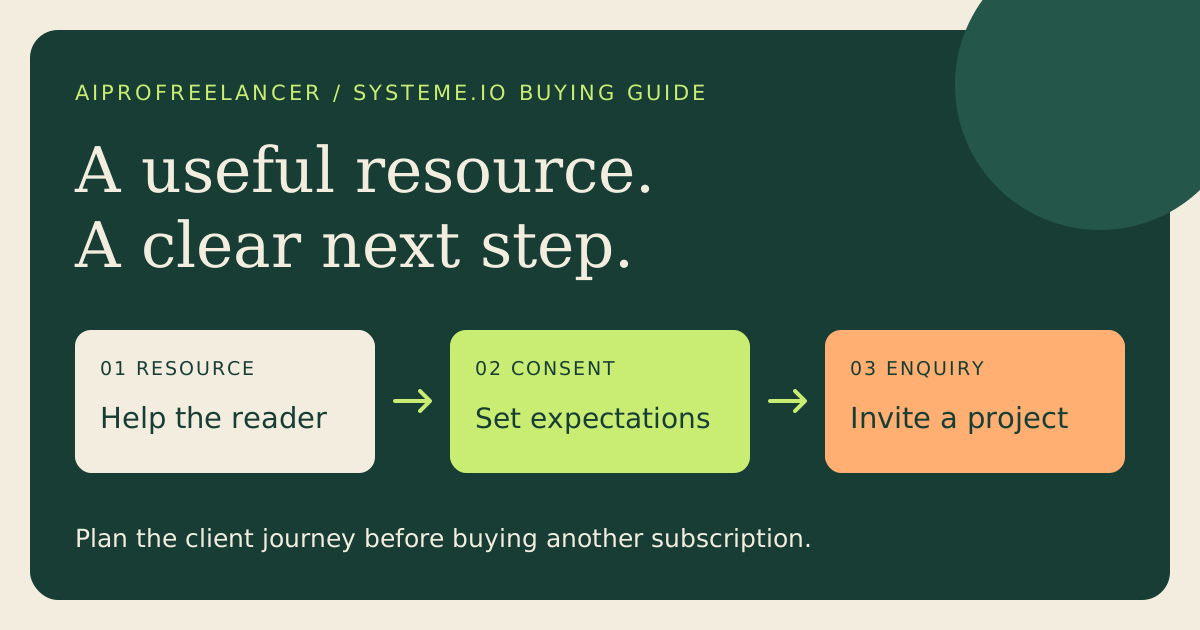
The proposed journey is: useful article or video -> opt-in page -> bridge page -> merchant. A follow-up email brings the subscriber back to your decision guide. The merchant handles its own checkout and affiliate attribution.
1. Match the lead magnet to the offer
Offer something useful before asking for a purchase. For a funnel-tool audience, a worksheet could help readers define their customer, signup promise, follow-up message and next action. Keep it specific enough that finishing it makes the software decision easier.
Avoid unrelated giveaways. A generic collection of business quotes may attract subscribers who have no reason to buy a funnel builder. A worksheet that exposes a real follow-up problem gives the bridge page a relevant job to do.
2. Create the opt-in and destination page
Draft the bridge page first so the signup has somewhere useful to lead. In the opt-in page editor, add a form with an email field and a submission button. Explain what subscribers receive and what follow-up to expect.
The form’s Actions settings support a custom post-submission URL and a double opt-in option. Set the destination to your bridge page and check the resulting signup behavior. Source: official form fields and post-submission settings , checked November 13, 2026.
3. Give the bridge page enough substance
Open with the promised resource and instructions for using it. Then explain the buying decision in plain language:
- Problem: What work is becoming difficult without the tool?
- Fit: Who benefits from this particular offer?
- Tradeoff: What limitation would make another choice better?
- Next step: What should the reader inspect on the merchant’s site?
For example, explain that a single follow-up journey can fit an entry plan, while separate audiences may require additional capacity. Show the reasoning instead of declaring the product perfect for everyone. Use an affiliate disclosure beside the recommendation and a clearly labeled outbound button.
Do not auto-redirect visitors or invent a countdown. Give them enough information to choose to stay, leave or investigate the offer. Begin with relevant readers from your own content; treat paid advertising as a separate project with its own destination review and budget.
Start with Systeme.io for your first affiliate funnel
4. Connect the email campaign
Prepare a short campaign before wiring the automation. In Automations > Rules, create a rule using the Funnel step form subscribed trigger, select the opt-in page, add Subscribe to campaign, select your campaign and save. Source: official instructions for automatic campaign enrollment , checked November 13, 2026.
Our suggested sequence is a resource-delivery message, a practical example and an answer to the main buying objection. These are editorial suggestions, not measured conversion results. Each message should help the reader finish a task even if they never buy.
Keep the initial automation simple. Check that the right subscriber enters the right campaign and receives the promised resource before adding more conditions. Use your own consenting test address and respect unsubscribe requests.
5. Preserve the merchant’s issued referral link
Paste the exact link issued by the affiliate program into the outbound button. Do not replace it with a plain product URL or assume that building a page in Systeme.io creates tracking for another merchant. Keep a small record of the offer, destination and approved promotion channels.
For Systeme.io’s own program, its documentation specifies the sa affiliate parameter and warns that adding www to its promotional links breaks tracking. Source: official affiliate link formatting instructions
, checked November 13, 2026.
Measure the handoff before upgrading
Track page visits, completed opt-ins, outbound merchant clicks and the merchant dashboard’s reported referrals separately. A click shows interest; it does not establish a paid sale or an approved commission. Record which article or video supplied the visitor so you can improve the right message.
If people visit but do not subscribe, revise the resource promise. If subscribers read the guide but do not investigate the offer, revisit product fit and the explanation of its limits. If the merchant reports no sales, inspect attribution and the offer before buying extra software.
Free accounts also have a $10,000 lifetime sales revenue cap. Payment pages stop accepting new sales at that cap until an upgrade; affiliate commissions are excluded. Source: official Free sales revenue rules , checked November 13, 2026.
That distinction matters if you later sell your own worksheet or course alongside affiliate recommendations. Review those sales separately from commissions. For the broader product assessment, read our Systeme.io review .
How to test it yourself in 15 minutes
Use this as a focused review after drafting the pages and emails, not a promise to finish the entire setup in that time.
- Open the opt-in on desktop and mobile. Check that the promise and form are readable.
- Submit your own permitted test address. Confirm the destination and any confirmation step.
- Inspect the contact and campaign enrollment. Check the actual delivery of the first message.
- Open the resource and review the bridge page. Can a reader explain who should buy and who should pass?
- Inspect the outbound button’s URL without generating a self-referral or purchase. Compare it with the program’s issued link.
- Check the unsubscribe journey and record unresolved issues before sending traffic.
FAQ
These questions address the public pricing and help topics cited above; they are not claimed as Search Console findings.
Is Systeme.io Free enough for an affiliate bridge page?
It is a practical starting point for the focused journey described here. Keep the page and follow-up requirements small, then verify the complete signup path in your account.
Do I need a checkout page to promote another company’s product?
For this workflow, the purchase takes place at the merchant. Your page explains the choice and sends readers through the issued affiliate link; it does not collect payment for that merchant.
Does one email campaign mean only one email?
No. A campaign is an email sequence. Use it to deliver the resource and follow-up messages for the same audience, following the campaign enrollment guide above.
Is Kit a better free alternative?
It deserves consideration for an original-content newsletter with occasional affiliate recommendations. Its larger free audience allowance does not override its content restrictions.
When should an affiliate marketer pay for Systeme.io?
Pay when a specific account limit blocks a working journey and the expected business value justifies the expense. Stay with the smallest suitable plan while improving the offer and traffic source.
Verdict: build one useful journey first
Start with a resource that solves a small problem, a bridge page that explains the purchase and a follow-up sequence that delivers useful help. Check the handoffs before scaling. Choose a paid plan when the existing workflow needs capacity, with the reason for that purchase written down.