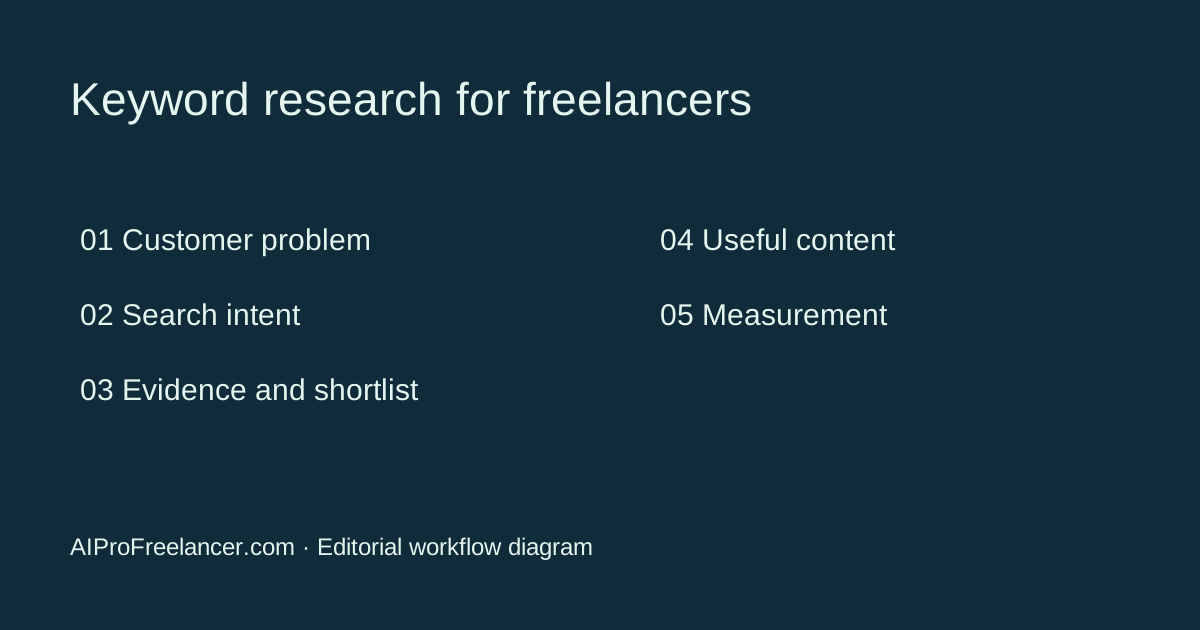
Keyword research for freelancers starts with a customer problem. A popular phrase is useful only when it describes work you can deliver or a question you can answer responsibly.
This is an editorial planning guide, not a ranking or conversion benchmark. The documentation-service ideas below remain unvalidated; a separate October 3 example records estimates and search-result observations collected from KWFinder.
Affiliate disclosure: We may earn a commission through marked Mangools links. Read our disclosure .
Choose your next step
- Need a plan first? Use the free keyword shortlist worksheet to record your audience, country, intent and existing page. No research subscription is required to start.
- Need location-specific estimates and a SERP view? Inspect KWFinder’s current offering and compare its current limits with the number of client projects you actually research. This is an affiliate link; tool estimates do not guarantee traffic or sales.
- Already have Search Console data? Follow the workflow below to improve an existing answer before paying for more keyword suggestions.
Choose one service and one customer
Write a brief: “I help [customer] solve [problem] with [service].” A documentation writer serving SaaS teams needs a different shortlist from a designer serving restaurants. Collect questions from actual projects, removing confidential details before using them publicly.
Possible documentation topics include help-center organization, onboarding and maintenance. Keep these as unvalidated ideas until you inspect results and demand.
Match the page to search intent
| Intent | Example idea | Useful page |
|---|---|---|
| Learn | How to organize a help center | Practical guide |
| Compare | Documentation writer vs technical writer | Comparison |
| Buy | Documentation writing for SaaS | Service page |
| Evaluate tools | Keyword tool for freelancers | Evaluation guide |
Give readers the answer they came for. Someone needing a checklist should receive it before an affiliate recommendation. A product earns its place when it solves the problem discussed.
Record evidence before choosing keywords
Create a table with query, customer, country, language, intent, source, observation date and planned URL. Add volume and difficulty only when collected. Leave unknown values blank.
Search Console provides queries associated with your website. Tool suggestions expand customer questions, but do not establish demand by themselves.
Continue when a research tool reaches its limit
Keep the existing shortlist instead of treating an upgrade as the next automatic step. For a website you own, open Search Console’s Performance report, record the date range and inspect queries and pages associated with your site. Use those observations to choose an existing answer to improve. For topics not represented there, record customer questions and inspect relevant search results; leave volume and difficulty unknown until measured.
Search Console impressions and clicks describe your site’s visibility, not the total number of searches in a market. A missing query does not prove there is no demand. Check the displayed report before interpreting an export: Google’s documentation
notes that unavailable values shown as ~ or - can become zeros in downloaded data. Preserve that uncertainty in the worksheet rather than presenting it as a measured zero.
Date the observations and keep query, page and country views distinct. Search results depend on the searcher’s context, so a manual search is not a reliable reconstruction of every position reported for your site.
According to the official KWFinder page , the tool supports keyword and domain research, historical volumes, difficulty metrics and location-specific search-result analysis. These are research inputs, not promises of rankings or income.
If those features fit your workload, explore KWFinder . Check current prices and plan limits on the vendor website before subscribing.
Inspect the search results
Check each query in the intended market. Note whether results are guides, service pages, directories or forums. A service query may need a service page rather than a product review.
Find a practical question the strongest relevant pages leave unanswered. Ask whether you can provide evidence, examples or clearer instructions. A low difficulty score alone does not establish that a new website can compete.
Give each URL a distinct purpose
A recorded example: five candidates, four usable result panels
On October 3, 2026, we inspected five queries in KWFinder with United States / English selected. These are examples from our software-publishing workflow, not proven keywords for a documentation-writing service.
| Query | Displayed monthly search estimate | Displayed difficulty | Result panel observed |
|---|---|---|---|
| murf ai review | 40 | 17 | Yes; cache age 18 hours |
| elevenlabs review | 250 | 18 | Yes; cache age 18 hours |
| anonymous vps | 140 | 28 | Yes; cache age 1 day |
| vps crypto payment | 40 | 20 | Yes; cache age 18 hours |
| murf text to speech review | 0 | 20* | No usable results in the initial panel |
Source: our recorded signed-in KWFinder UI observations on the date above. The figures are vendor estimates, not traffic received by this website or measured conversions. The last query’s difficulty appeared later as a related-term value; it was not established by a usable result panel for that query.
The voice-review panels included review articles and other result types, while the VPS queries also included providers and forums. We interpreted these as reasons to examine buying questions and existing pages, not proof of an easy ranking opportunity. Four cached panels do not constitute five complete result inspections.
The practical decision was to improve existing review and VPS pages, then provide a separate voiceover scorecard for the sample-evaluation task. That preserves a distinct purpose for each resource instead of publishing another near-duplicate product review.
A displayed zero or an unavailable panel should stay qualified: it does not establish that nobody searches for the topic. Global estimates, another country or a later database refresh can differ. Keep the market, date and result availability beside the numbers before choosing a page.
Check existing pages before writing. Update a page when the reader need is unchanged. Create a separate page when the purpose differs: setup tutorials and product evaluations answer different questions.
Our Ahrefs–Semrush workflow comparison explains how to compare account limits and required outputs before buying a broader SEO suite. Verify the current plan details for the task you need to complete.
For the subscription decision, read our Mangools and KWFinder review . It separates recorded query observations from account limits and explains what to check before paying.
Turn the shortlist into a recorded decision
Use our free keyword shortlist worksheet to record the market, search intent, existing page, evidence and next reader action for each candidate. It includes a blank download and separates targets from observed results. The worksheet does not require a paid tool or forecast traffic; use it to decide whether to update, create or defer a page.
Write a brief that can be checked
Include the reader, question, evidence needed, outline and next step. Use an original or permitted image. Explain limitations near recommendations, and distinguish documentation from testing. Avoid ratings implying a benchmark you did not perform.
Measure each stage separately
Track impressions and organic clicks in Search Console, visits in analytics, and affiliate clicks separately. Confirm approved conversions and payments in the affiliate platform.
Few impressions suggest investigating indexing and coverage. Impressions without clicks suggest checking titles and intent. Visits without useful next steps suggest improving the article. Affiliate clicks without conversions call for checking offer fit and attribution.
Compare equivalent date windows and record changes. Small samples move sharply after one click; do not rewrite your strategy from a single day’s percentage.
Common questions
Do I need a paid tool immediately?
Start with customer questions and existing Search Console data. Consider paid research when you need more ideas or market-specific analysis. Check plan limits against your workload.
Should I choose the highest-volume keyword?
Choose relevance and intent first. A popular phrase attracting people outside your market may be less useful than a smaller query describing a problem you can solve.
How many articles should I publish?
Leave time to check facts, improve existing pages and inspect results. Several overlapping pages do not substitute for one useful answer.
Does keyword research guarantee affiliate income?
No. Offer quality, visitor needs, attribution and purchase decisions matter. Research is a planning tool, not a revenue guarantee.
Next step: record five candidate queries, inspect results and select one page to improve. If needed, view KWFinder’s current offering .