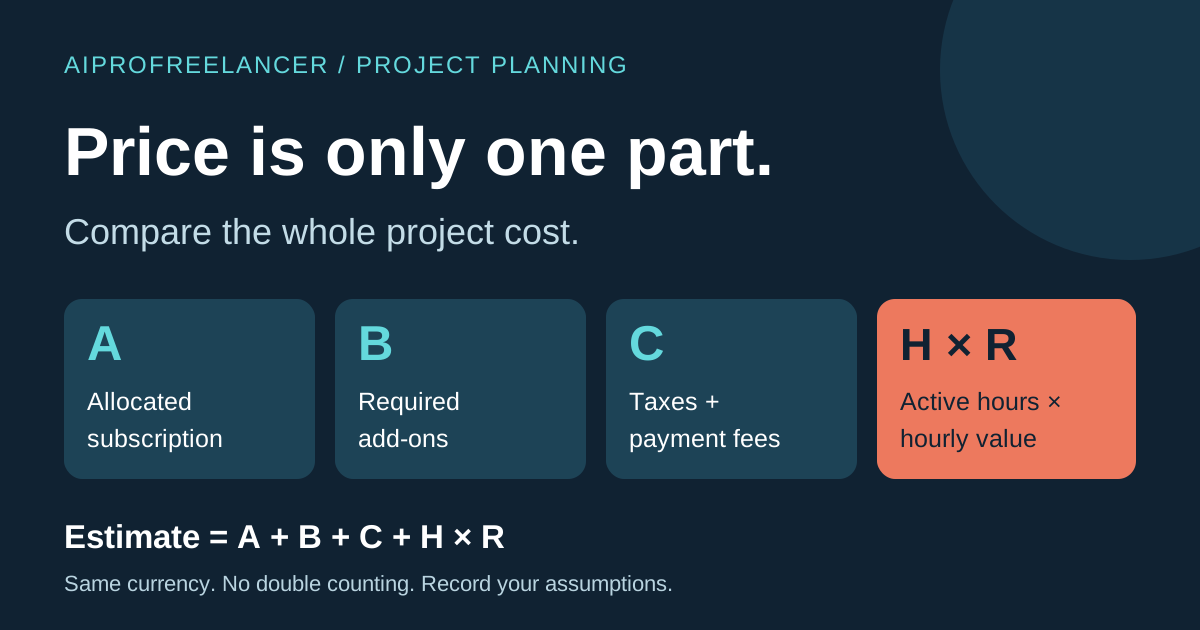
A low subscription price does not tell you what a tool will cost on a client project. Setup, revisions and export cleanup can change the comparison. Before subscribing, estimate the cost of the complete deliverable and keep the assumptions visible.
Download the blank freelance tool cost worksheet . The worksheet contains no vendor prices or promised earnings.
Disclosure: Related reviews linked below contain disclosed affiliate links. This cost method does not require buying a product.
Record the payment you actually commit to
Write down the plan, billing period, payment due now, renewal amount and cancellation terms shown at checkout. An annual plan advertised with a monthly equivalent still creates a different cash commitment from a monthly plan.
Separate that cash payment from the portion you allocate to one project. If several projects use the subscription, explain your allocation method. Equal allocation might be reasonable for similar projects but misleading when one project uses most of the allowance.
Use one currency for the comparison. Record the exchange rate and its date when a vendor bills in another currency. Include taxes and payment or currency-conversion fees that you actually bear; leave uncertain charges as unknown rather than assuming zero. Do not add a charge twice if the checkout total already includes it.
Also list the capabilities required to finish the work: extra seats, export formats, higher usage limits or an add-on. Leave unknown costs marked unknown until the vendor’s current terms resolve them.
For example, an annual payment of 120 currency units shared equally across 12 comparable projects allocates 10 units per project. If only six projects use the plan, the allocation becomes 20. The payment due now remains 120 in both cases. These are hypothetical inputs; record your own project count and allocation basis.
Include your active working time
Record setup, production, revisions and handoff separately. Measure a representative sample when possible. Keep estimates labeled as estimates and avoid presenting them as observed performance.
Your working-hour value is an input you choose for planning; it is not a claim about market rates or guaranteed earnings. Apply the same value to the baseline workflow and the candidate so the comparison remains consistent.
Use a simple project formula
Estimated project cost equals allocated subscription fees plus required add-ons plus allocated taxes and payment fees plus active working hours multiplied by your chosen hourly value.
For a hypothetical example, suppose allocated fees are 10 units of currency, required add-ons are 5, additional taxes and payment fees are zero, working time is 2 hours and the chosen hourly value is 15. The estimated cost is 10 + 5 + 2 × 15 = 45 units. These are invented teaching inputs, not a vendor quote or a forecast for your business.
Change the revision time to four hours and the same calculation becomes 75 units. That difference explains why a feature demo alone cannot establish the economic value of a workflow.
Check delivery requirements before comparing savings
A cheaper workflow is not usable if it cannot provide the client’s required deliverable. Verify the final format, editing permissions, relevant usage rights and any consent needed for supplied material.
Open an exported sample in the application the client intends to use. Include cleanup time in the estimate. Do not assume that generating a draft, downloading a file and delivering an approved result are the same milestone.
Our voiceover evaluation scorecard helps record voice revisions and separate licensing gates. The Beautiful.ai buying checklist applies similar questions to presentation exports and client handoff.
Compare against your existing workflow
If your baseline uses a free account, use the free-tool limits checklist to check required exports, collaboration and upgrade triggers before entering a zero subscription cost. Free access does not remove production or revision work.
Use the same scope and quality requirement for both options. Record what happens if the project needs another revision or if fewer projects share the subscription than expected. A comparison that works only under optimistic assumptions should stay tentative.
An estimated saving is not cash received. Keep it separate from paid invoices, approved affiliate commission or actual withdrawals. The goal of the worksheet is to improve a purchase decision with explicit inputs, not to manufacture a positive return.
Keep the terms and observation date with your decision. Recalculate when the plan, usage, project scope or delivery requirement changes.